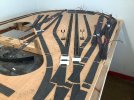
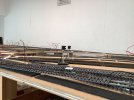
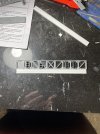
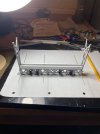
Monks Ferry: a layout for the Grandchildren.

Phil O

Western Thunderer
Jon, am I right in thinking that you want the lamp head to be vertical on the top of the post? You need to know the taper of the post 1 in xx. Pack the post to the thickness that will put the centre line of the post laid on its side horizontal, then add packing above the top of the post to bring the head to where you want it positioned.

HTH.
 

jonte

Western Thunderer
Jon, am I right in thinking that you want the lamp head to be vertical on the top of the post? You need to know the taper of the post 1 in xx. Pack the post to the thickness that will put the centre line of the post laid on its side horizontal, then add packing above the top of the post to bring the head to where you want it positioned.

HTH.

Hi Phil and thanks for your interest and generous sharing of your knowledge.

I confess I know very little about such matters and am inspired merely by something which appeals in form.

In truth, this was a hybrid and therefore only loosely based on prototype practice, mainly for ease of construction and the appeal of a simply fabricated double-starter at Kings Cross in one of Brian Dales’ photos in his gallery.

I’m disappointed that I haven’t managed to pull this off, as I like making things, the challenge of which normally spurs me on. However, on this occasion it’s a mixture of lethargy and disinterest in progressing matters further, rather than a lack of skill set which I think Alan @Alan was alluding to. Whilst Alan commendably recognises his own limitations, and believe you me I’m well aware of my own, soldering stuff up isn’t an issue, but the realisation that I’m in need of a replacement iron and at least one bit (which would have helped immensely here) whilst waiting around for the items to arrive, coupled with having to adjust the jig yet again, to say nothing of requiring six or perhaps seven of the signals, only compounds my lukewarm interest.

I’ve still a couple of ideas in mind, but latest thinking is to opt for the plastic Dapol gantry kit which is of a similar material as the signal canopies that I’m returning to, and which should ease construction somewhat. It’ll also be easier to hide the wires and the boxy bit to the rear of each canopy. In other words: a quick fix.

I realise that most termini had starter signals on posts, however, Queens Street to my knowledge used a gantry, and when all’s said’n’ done, it’s just a layout for the children.

Thanks once again for your offer of assistance and interest, Phil.

Jon
 

jonte

Western Thunderer
The gantry kit arrived in this afternoon’s post so thought I’d make a start yo familiarise myself with the kit, locate where it will stand on the layout and make a start.

After some filing, sawing and jiggling of the frame and canopies to fit, they are now where I need them:

IMG_0173.jpeg

I’ve reamed out the holes for the bulbs to afford them a deeper seat inside the canopy.

The next job will be to fit the canopies to the other side, then I’ll look to fitting the bulbs and wires for ease of construction prior to bringing the two gantry sides together.

Lots to consider.

jonte
 

jonte

Western Thunderer
The other side:

IMG_0174.jpeg


Think I’ll add a spot of superglue to the rear of each hood/canopy next time at the bench for belt and braces.

Then I’ll seat the bulbs and work out how I’m going to secure the run of wires, bearing in mind they might have to be replaced at some time in the future.

Then to gluing it all together………..

jonte
 

jonte

Western Thunderer
Just as a footnote to my previous posts of yesterday, and to show how handy photos can be, it was only later on examining the accompanying photos that I realised I’d got the adjoining gantry sections on the first photo the wrong way round (the ‘X’ should be on the middle ), and in the second, the two signals on the right of the picture should be the other way around (the three aspect should be to the outer and vice versa……). A further visit to the workshop in the wind, rain and darkness before bobos last night saw me sawing up the gantry frame once more and replacing the two with a three. The idea was to have a 3 aspect for trains arriving to show them availability of the platform on the diverging side, if that makes sense? Me just trying to be clever….I know very little if anything about signalling. Unfortunately, I couldn’t just swap the signals round as drastic action has to be taken to accommodate the three ways ie the cross member has to be cut and filed away for access to the middle light, so,I just added another:

IMG_0175.jpeg

Why I am boring you all with this?

Well, just to show as an example of how tiredness and too long at the bench can result in errors.

I enjoyed a full day’s modelling yesterday, and to make the most of it, I started in darkness. ‘But I thought the gantry kit didn’t arrive until the afternoon post?’. It didn’t.

I started the day determined to try and convert those Dublo double signals to led.

I’d grown fond of their vintage look, but the ‘trout-pouted’ look of the pokey-out lamps of old, akin to the average driver of many SUVs these days, just had to go!

But what a struggle it turned out to be (unnecessarily de-wiring then realising it wasn’t necessary, the idea being to secrete the ugly wires at the rear inside the housing of the lamps). But it just wasn’t to be, even though those mummified wires are the thinnest I’ve ever seen. Then I tried scraping the paint off the insides of the hoods to solder the cathodes to, but the solder broke off (I later realised that the white metal required a different solder, which thankfully I had - but wasn’t required as the meter showed a contact). Still, for belt and braces, I took a wire from the cathodes amd routed it out from the inside (this was possible as I used a single strand of wire for the purpose). Carefully threading through the base and nestling it in amongst the other wires down the stacmchion, blu-tac assistance, and attaching a resistor betwthe wire and the connection on the base, after several gos of attaching the rear of the hood and then undoing it, the lights eventually worked!

Then I repeated the proceed procedure for the second set on the stanchion. Despite using a double resistor in parallel, there was no joy from either set, despite the meter showing good connections, so I fitted a separate resistor to the second wire, and bingo, they all worked. But after putting it all back together, and reapplying the feed, there was nothing.

No amount of fiddling after this could rectify matters.

My knowledge amd patience deserted me, and the gloom of failure once more descended…..

I didn’t take a picture of the base electrics, but to give an idea of how the wires are routed in these signals, here’s a piccie from earlier in the week:

IMG_2920.jpeg

Anyway, I submit in an attempt to justify my lack of concentration and it’s consequences.

Back to grand parenting duties today and tonight which will come as a welcome distraction……

Hopefully I’ll return with a finished and working gantry.

Wish me luck.

Thanks all for your interest and likes and also your endurance.

jonte

 

jonte

Western Thunderer
As usual, one or two concerns came to mind since my last (in fact threefold) which has led to a spot of kitbashing this evening.

The problems to overcome as I saw it were as follows:

In the event of a bulb failure, would I be able to gain access to change it, and secondly, as the kit is intended for signals in a single direction, should I therefore create a second access platform instead of just the one provided as I’m intending to site signals both sides of the gantry? Thirdly, despite using thin wires from a USB lead as suggested by @adrian, it would still prove difficult to secrete them within the gantry frame.

The answer to the second was easy: Yes; it would look a little odd without it. However, it was the presence of these platforms that would only add to the difficulty of access should it be required (leds are reputedly made to last, but with the ill luck I’ve been experiencing of late, I’d be lucky to get a weeks’ service). Bearing in mind that access above and below is restricted by the narrow gap above and below the gantry, it would be beneficial if one could also poke their pinkies through the gaps in the frame, however a fixed gantry with flimsy handrails protruding would put paid to this, so any solution would have to make them detachable. To this end, and after a route through my plasticard spares draw, I came up with this:

IMG_0176.jpeg

……a base of styrene sections that should be deep enough into which the wires can be secreted (they’re a millimetre or so shorter in length than the gantry span to allow for the protruding supports on the uprights) and then drilled to allow brass wires (yet to be cut to size) to be inserted onto which the scratchbuilt platforms will be hung:

IMG_0177.jpegIMG_0178.jpeg

In the middle photo, you can just make out the two double height sections for the front and rear sections of the gantry, and four single height styrene sections onto which the two platforms will be constructed.

When access is required, the platforms can be slid off to improve access.

Handrails will be soldered up from brass pins and some left over handrail wire from a Finney kit (if I can trace it).

The brass wires will also be handy for hanging the signal wires off before they descend inside the uprights and out of sight through a hole in the foot of the gantry.

Well that’s the idea.

Cheers for now.

jonte
 

jonte

Western Thunderer
Another odd hour or two here and there on the build has seen the fitting of the opposite scratchbuilt crossmember.

Priority has been to keep the two halves of the gantry crossmembers separate, at least until the bulbs are fitted plus I can prime and paint the insides a lot more easily.

The problem here was ensuring that the scratch built sections were fitted such that the holes for the brass rods lined up. After much umma-ing and ahh-ing, I decided that the only way forward was a compromise (isn’t it always..) and to attach the the already fitted crossmember to the uprights. The unfitted crossmember is seen friction fitted:

IMG_0181.jpeg

IMG_0180.jpeg

The friction fitted crossmember was secured with a couple of blobs of blu-tac and the whole construct was turned upside down and secured to a piece of graph paper to assist with alignment of the brass rods, after which a witness mark was pencilled on the scratchbuilt crossmember glued on, the brass rods being refitted to ensure true-ness:

IMG_0183.jpegIMG_0184.jpeg

It quickly identified that not all four holes were inline…….No matter, three will still do the job as the platforms will be made more to robustly than the Dapol design.

There are wider gaps at one end as I didn’t realise that the inner sections of the uprights have no relief. Despite acknowledging this albeit afterwards, I still managed to fit one with the detail on the ‘inside!’…….. I reckon I’ll use some thinner styrene section to make up the missing detail, although none of this is to the fore at present as just getting this darned thing to work is my ultimate goal; anything else I can address or simply live with.

Incidentally, I’m intending to keep things simple electrically by using on/on switches as most are simply red/green aspects which are easier for the children (and me) to understand.

However the three aspect variants, of which there’ll be two, I’m intending to operate as ‘red’ or ‘amber and green’.

I’m sure this can be done with an on/on switch, simply using two resistors in series for the amber and green option?

I was thinking of using a rotary switch (single pole version), but in my infinite wisdom, ended up ordering a potentiometer by mistake. I really don’t need to dim the lights……….

If any WT-er who is likely more enlightened on such matters, their kind thoughts in this regard would be appreciated.

Cheers

jonte
 

simond

Western Thunderer
Jon,

copy this

“3 aspect signal wiring diagram”

into google and be amazed at the wealth of information available!

much depends upon your ambitions to have the aspect dependent on that of the following signal.

hth
Simon
 

jonte

Western Thunderer
Jon,

copy this

“3 aspect signal wiring diagram”

into google and be amazed at the wealth of information available!

much depends upon your ambitions to have the aspect dependent on that of the following signal.

hth
Simon

Many thanks as usual Simon for your prompt response and interest. I’m much obliged.

Yeah, I did that Simon, but many involved the use of an arduino or other gizmo between the switch and signal.

Another guy used DPDT switches in series but there was nothing I could find in regard to a rotary switch for the purpose, which I’d prefer.

So for instance, let’s say that I opted for the usual 12 position item and that all things being equal, the positions were all fir output (in other words, they were not feeds like in some cases), then the idea was to designate position 2 for a red signal, with position 1 say being allocated fir green, and 3 fir amber and green.

Also, many seem rotary switches are deemed either two, three or even more poles which I think would only complicate the wiring?

I’m considering the single pole version which I think would be adequate for the purpose described and less of a wiring nightmare (although I could be wrong on this) however, if somebody could offer me reassurance on this idea I’d be most grateful.

Thanks again, Simon.

Jon
 

Yorkshire Dave

Western Thunderer
On a Swiss layout I had many moons ago I used a three bank of interlocking latching switches to control the colour light signals - similar to those used in old (Grundig) radios to change the wavebands.

As you pressed the switch for the green light it released the red light switch. Press for the amber light it released the green light switch and so on. Each time it displayed a single aspect. As the Swiss use speed signalling I could switch down the green and amber lights which were both released when the red switch was pressed.
 

jonte

Western Thunderer
On a Swiss layout I had many moons ago I used a three bank of interlocking latching switches to control the colour light signals - similar to those used in old (Grundig) radios to change the wavebands.

As you pressed the switch for the green light it released the red light switch. Press for the amber light it released the green light switch and so on. Each time it displayed a single aspect. As the Swiss use speed signalling I could switch down the green and amber lights which were both released when the red switch was pressed.

That’s interesting to know, Dave, as this has cleared up something that was puzzling me with regard to using a potentiometer for the purpose of signalling. The main purpose, it transpires, was to alter the resistance and thus the brightness of the bulb (something I recall you touching on before), however the second was as you’ve described but not as clearly. Apparently it assists in a seamless change of aspect by allowing the operator to alter the speed of change of phase.

Many thanks.

I’ve ordered a couple of single pole rotary switches as mentioned which was my original intention and will give them a go.

Best,

Jon
 

simond

Western Thunderer
Jon,

You can use single pole rotary switches, as long as you only want one light at a time per switch

on the switch there will be a common “C” tag, and several ”NC” tags each of which will be connected to the common as you turn the knob. So wire Red Amber and Green to three consecutive tags, and the other side of the lamps to ground (via resistors if LEDs), and the common tag to live.

Some switches have up to 12 positions, and you can put pins in to limit the ones it can get to.

hth
Simon
 

jonte

Western Thunderer
Thanks, Simon, but I’m sure I read somewhere or other that you can wire two leds together so that they light at the same time so long as you use two resistors in series connected to their cathodes (and that was in relation to using a simple on/on switch).

I guess I’ll find out one way or t’other when they drop on the mat hopefully tomorrow.

If not, I’ll dig deep and phone Clive at Heathcote.

Cheers.

Jon
 

jonte

Western Thunderer
More woe……..

Fiddling with this thing last night fir a couple of minutes or so I realised that try as I might, it would prove easier for a camel to pass through something exceedingly small than my slender pinkies being able to poke between those narrow gaps in the plastic girders. Yes, there’s still access above and below however whilst it might be a bit of a fiddle to change the bulbs in a two aspect, I’m afraid it would be a significant challenge to get at the middle bulb in the three aspects without breaking something; I know it would happen.

The thought having to sling it all in the bin due to one failed bulb brought me out in a cold sweat, but with my run of bad luck of late, a failure seemed inevitable. There was no choice but to ensure that the unattached girder section was made to be removable. But how?

An early start following a restless night mulling over one or two bum ideas resulted in this:

IMG_0187.jpeg

Two holes at each end of the unattached girder beam into which (loose) thin wires can be inserted. They were gingerly opened out with a series of tiny drills in a vice drill:

IMG_0188.jpeg

They will now need cutting to size and the plastic surrounds tidied up, but at least they work in principle.

I’ll secure them with paint when the time comes so that they will still be removable with the aid of the side of a screwdriver blade in the event of a blown bulb.

Now onto the next little issue or two.

jonte
 

jonte

Western Thunderer
Yes, you can wire them in parallel (with their series resistors) if you want them always to light up together.

Thanks, Simon.

Perhaps it might help if I explained my ‘notion’. My apologies, I omitted to do so and it might have helped.

Due to clearance issues, I decided to play safe and move the gantry to the set of points serving the bays, by which time I’d already fitted the mix of two and three aspects (my haste causing unnecessary issues once more!).

Whilst I’m busy writing out my expanse of knowledge of signalling on the proverbial postage stamp, may I just say that I read somewhere or other that the illumination of an Amber and green signal together means that the road from a diverging rail is clear, (the roads to the outside platforms) so that’s the idea I’m lumping for; a sole green light meaning the road head is clear for the dead-ahead lines (the centre platforms).

I’ve probably just dreamed all this up, but I’ll go with it. If anybody queries, I’ll just say I came across the directive in the signalman’s book found in Monks Ferry’s signal box upon its demolition ;)

Many thanks for sharing once again.

Jon
 
Top