
You are using an out of date browser. It may not display this or other websites correctly.
You should upgrade or use an alternative browser.
You should upgrade or use an alternative browser.
Monks Ferry: a layout for the Grandchildren.
- Thread starter jonte
- Start date

jonte
Western Thunderer
Just a thought, I think there is a missed opportunity here to put in a right hand point in place of the connecting curve to the left of the diamond. Personally I feel that would flow a little better and hide the appearance of reverse curves within the pointwork.
Colin
Hi Colin, and many thanks for your assistance.
Please forgive my ignorance, but do you mean replacing the curved section (ringed in red in the below photo) with the right hand point as you point out?:
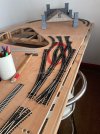
Indeed, this was the amendment I mentioned to Tim in my last to allow trains to enter and exit simultaneously.
This is a ‘bespoke’ section of track cut to size from a standard Hornby curve of radius 3 fabricated to fit, as a 2nd (single) radius curve was too sharp a radius to match up with each of points it connects and a tad short to cover the gap. This rather puzzled me at the time as I automatically assumed that a 2nd radius curve to match those of the points would have been ideal. Here is the radius 3 curve overlapped onto the points either end prior to me cutting it to fit, which hopefully shows a harmonious path between:

As you will no doubt be aware, Colin, (standard) Hornby points are of radius 2 so wouldn’t have matched or been long enough to fit the gap.
Incidentally, thinking about the length of gap between, I think this may be due to the diamond crossings supplied by Hornby being ‘handed’, thus the lengths of rails which cross are different, one side being shorter in length than the other, although this is just my supposition.
Hopefully I haven’t gone off at a tangent; please let me know if I’m barking up the wrong tree.
Cheers.
Jon

John57sharp
Western Thunderer
Whatever the above conundrum results in, I can’t wait to see the trains snaking through that lot!
Lucky grand-children - just like I was.
John
Lucky grand-children - just like I was.
John
jonte
Western Thunderer
Whatever the above conundrum results in, I can’t wait to see the trains snaking through that lot!
Lucky grand-children - just like I was.
John

I winced when I looked at the photo, John, as these Bachmann jobs look a little too close for comfort.
In practise, they flew through without event (although coming out - which they wouldn’t as this would be in the wrong direction- one of the wheel sets struck the nose of the frog as I mentioned in another post, which will require a resetting of the btbs).
Even though the reverse curve is of third radius, I still wouldn’t risk a long wheel based kettle, this being the preserve of EMUs (that’s something else I’ve to address: live third rail!).
Many thanks for your kind words and interest as usual, John

Jon
I wouldn’t want to be walking through the gangways when the train was using that line!View attachment 239414
I winced when I looked at the photo, John, as these Bachmann jobs look a little too close for comfort.
In practise, they flew through without event (although coming out - which they wouldn’t as this would be in the wrong direction- one of the wheel sets struck the nose of the frog as I mentioned in another post, which will require a resetting of the btbs).
Even though the reverse curve is of third radius, I still wouldn’t risk a long wheel based kettle, this being the preserve of EMUs (that’s something else I’ve to address: live third rail!).
Many thanks for your kind words and interest as usual, John
Jon
I think you could improve things a little by moving the turnout on the mainline further away from the diamond crossing. Exchange the position of the turnout and the short straight length. A second equal short straight will then be needed in your by-pass loop.
Moving the turnout on the mainline further back again would be even better. If you did that, you would have a straight section on the by-pass loop long enough to take the connection to the sidings off there.
jonte
Western Thunderer
I wouldn’t want to be walking through the gangways when the train was using that line!
I think you could improve things a little by moving the turnout on the mainline further away from the diamond crossing. Exchange the position of the turnout and the short straight length. A second equal short straight will then be needed in your by-pass loop.
Moving the turnout on the mainline further back again would be even better. If you did that, you would have a straight section on the by-pass loop long enough to take the connection to the sidings off there.
Sounds a good solution, 40057, thank you.
A little busy today so will try and investigate tomorrow.
Thankfully, nothing fixed down yet.
Jon
jonte
Western Thunderer
My daughter arrived with the children early this morning with a birthday present for Grandad.
To say I was pleased would be an understatement. A quick test with the kind assistance of my grandaughter on DC, saw it running as smoothly as silk and quiet as a mouse.
Posed under the station roof prior to returning it to its box for the present, I think it rather looks the part:

jonte
To say I was pleased would be an understatement. A quick test with the kind assistance of my grandaughter on DC, saw it running as smoothly as silk and quiet as a mouse.
Posed under the station roof prior to returning it to its box for the present, I think it rather looks the part:
jonte

timbowales
Western Thunderer
Lucky you 

Roger Pound
Western Thunderer
Delightful!
Roger
Roger
jonte
Western Thunderer
Yes, I did mean that section, like you I find it bizarre that a point fits at the other side of the diamond - but I think you are on to something and there is asymmetry in the Hornby diamonds. It's a while since my track planning set has seen daylight and even longer since I actually used OO set trackHi Colin, and many thanks for your assistance.
Please forgive my ignorance, but do you mean replacing the curved section (ringed in red in the below photo) with the right hand point as you point out?:
Indeed, this was the amendment I mentioned to Tim in my last to allow trains to enter and exit simultaneously.
This is a ‘bespoke’ section of track cut to size from a standard Hornby curve of radius 3 fabricated to fit, as a 2nd (single) radius curve was too sharp a radius to match up with each of points it connects and a tad short to cover the gap. This rather puzzled me at the time as I automatically assumed that a 2nd radius curve to match those of the points would have been ideal. Here is the radius 3 curve overlapped onto the points either end prior to me cutting it to fit, which hopefully shows a harmonious path between:
As you will no doubt be aware, Colin, (standard) Hornby points are of radius 2 so wouldn’t have matche or been long enough to fit the gap.
Incidentally, thinking about the length of gap between, I think this may be due to the diamond crossings supplied by Hornby being ‘handed’, thus the lengths of rails which cross are different, one side being shorter in length than the other, although this is just my supposition.
Hopefully I haven’t gone off at a tangent; please let me know if I’m barking up the wrong tree.
Cheers.
Jon

Colin
John57sharp
Western Thunderer
A most elegant locomotive in my very biased opinion!
John
John
jonte
Western Thunderer
Yes, I did mean that section, like you I find it bizarre that a point fits at the other side of the diamond - but I think you are on to something and there is asymmetry in the Hornby diamonds. It's a while since my track planning set has seen daylight and even longer since I actually used OO set track
Colin
Thanks, Colin.
Jon
jonte
Western Thunderer
I wouldn’t want to be walking through the gangways when the train was using that line!
I think you could improve things a little by moving the turnout on the mainline further away from the diamond crossing. Exchange the position of the turnout and the short straight length. A second equal short straight will then be needed in your by-pass loop.
Moving the turnout on the mainline further back again would be even better. If you did that, you would have a straight section on the by-pass loop long enough to take the connection to the sidings off there.
Good morning 40057
As you were kind enough to make this helpful suggestion, I popped out to the modelling room earlier to explore your proposition.
To remind ourselves of the layout of the junction, here’s one as it stood, the short reverse curve standing out like the mid section of Max Wall’s legs:
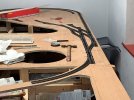
Before I address the rearrangement of the turnouts that create the presence of a precarious reverse curve as you have correctly observed, I just want to direct you to the ‘entry’ point of the junction with specific reference to your suggestion of moving the entrance points as far away as possible from the terminus to minimise the effects of a reverse curve in this situation.
The problem here is that the further most point of the junction/station throat from the terminus is governed by the turnout that marks the exit point of the return loop as (hopefully) can be seen here:

The turnout to the left of the picture is the exit from the ‘loop’, that to the right, the entry to the junction on the up line (the furthest point from the terminus). Here is an elevated view:
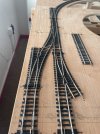
Respectfully, as can be seen, all I would gain here is a couple of inches following the removal of the short section of track between, which I would be reluctant to do as it was placed here deliberately to separate the turnouts involved. This formed one of the list of ‘must haves’ prior to drawing out the track plan. Why? Well, it was to combat one of the many annoying issues with proprietary track recalled from childhood memories, and that was the derailment of trains when turnouts were placed immediately back to back, especially at speed. I remember that placing a straight section of track in between seem to resolve the issue, thus this became a rule at Monks. So I think I’ll leave well alone.
Now to the rearrangement.
I suppose it would be simplest to start by saying I achieved your excellent suggestion, 40057, but via a slightly different arrangement. In the end, however, the same outcome has been achieved: the ‘lengthening’ of that darned reverse curve(!) and a more gainful approach to the Van sidings.
This was achieved by removing the left handed turnout immediately prior to the diamond and thus the ‘lead’ to the reverse curve, and replaced with a piece standard Hornby straight of the same length.
The turnout which became an addendum to facilitate the van sidings to the left of the station, and which I sited just prior to the turnout which I removed, now became the entry to the reverse curve, lengthening the curve in the process as you were advising.
The ‘bespoke’ curve fashioned from a Hornby double length curve of 3rd radius which formed the reverse curve, was then joined to the diverging road of the turnout, to form a link between this turnout and the one at the terminus end of the diamond crossing to complete the lengthened reverse.
Now, in between was placed another left handed turnout to form a straight section and also a point from which a road could be taken to form the van sidings, which left just a minor gap, completed by the insertion of another standard short section of Hornby track (I’m so glad I invested in a variety of lengths of Hornby track when purchasing other bits n pieces from a supplier….).
The setting out of my amendment to the ‘loop’ with the right hand turnout prior to the diamond still in place and the ‘bespoke’ curved section now joined to the turnout that was the proposed lead to the van sidings:

The standard shirt section added to complete the reverse curve ‘loop’ (with slight gaps left between joints as a defence against excessive expansion due to increased heat in summer in there):
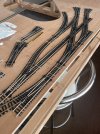
The standard curve fitted at the end which will lead to the van sidings can also be seen.
An overall view of the new layout:
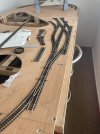
Many thanks once again 40057 for your valued contribution and to those WT-ers have flattered me with ‘likes’ and interest; I sincerely hope and trust the above wasn’t too confusing.
Now to get on building it lest I have to change the title to: ‘a layout for the Great Grandchildren’.
jonte
timbowales
Western Thunderer
Very tidy!
jonte
Western Thunderer
Thanks, Tim.Very tidy!
Only the silhouette remains to tell the tale; thankfully.
Jon
jonte
Western Thunderer
Laying of the straight sections from Peco flexitrack to join it all together began in earnest yesterday, and by early evening I was onto the other side with only several more infills to cut.
Then the track cutters gave up the ghost…….
Why do these things always seem to happen on a Bank Holiday weekend?
I’ve two sets: the current ones - of mediocre quality but do/did the job - were purchased from a local model shop a few years ago; the older and better quality Xuron’s had seen a lot more action and had been consigned to cutting the ends of stray wires and such as they were no longer up to the job, both of which can be seen in the following photo, and in which you can see the early progress of these sections to the left of the photo.

In an effort to expedite the laying of these track sections, I’ll make a dash down the motorway to the nearest reliable and better stocked model shop this morning to hopefully purchase a new set. If they’re out of stock, It’ll be almost another week before I can continue.
What a bummer!
jonte
Edit: I meant to add the following in the text.
In yesterday’s response to 40057, I made mention of my dislike of turnouts being back to back without a straight section of sorts in between for reasons given. In the above photo, you will see to the lower right of the picture an instance where I have broken this rule. This was necessary for reasons of space: platform lengths and thus train lengths are typically train set short due to restrictions of space; by placing them back to back, I’ve managed to save a few more inches in the interests of premium land. In any case, it shouldn’t be an issue with the slow speeds expected in the station area……..unless grandad turns his back. jonte
Then the track cutters gave up the ghost…….
Why do these things always seem to happen on a Bank Holiday weekend?
I’ve two sets: the current ones - of mediocre quality but do/did the job - were purchased from a local model shop a few years ago; the older and better quality Xuron’s had seen a lot more action and had been consigned to cutting the ends of stray wires and such as they were no longer up to the job, both of which can be seen in the following photo, and in which you can see the early progress of these sections to the left of the photo.
In an effort to expedite the laying of these track sections, I’ll make a dash down the motorway to the nearest reliable and better stocked model shop this morning to hopefully purchase a new set. If they’re out of stock, It’ll be almost another week before I can continue.
What a bummer!
jonte
Edit: I meant to add the following in the text.
In yesterday’s response to 40057, I made mention of my dislike of turnouts being back to back without a straight section of sorts in between for reasons given. In the above photo, you will see to the lower right of the picture an instance where I have broken this rule. This was necessary for reasons of space: platform lengths and thus train lengths are typically train set short due to restrictions of space; by placing them back to back, I’ve managed to save a few more inches in the interests of premium land. In any case, it shouldn’t be an issue with the slow speeds expected in the station area……..unless grandad turns his back. jonte
Last edited:

simond
Western Thunderer
Probably less of an issue in 4mm but when a Xuron does fail, there is a fairly impressive “bang” and the broken jaw exits stage left at supersonic speed unless it embeds itself in something first.
I wear glasses anyway for close up work, but I do wonder whether some more substantial protection is in order.
Bless his little cotton socks, I feel Jeff Bezos should be able to personally deliver a pair tomorrow. Handy having your own private fleet of rockets.
I wear glasses anyway for close up work, but I do wonder whether some more substantial protection is in order.
Bless his little cotton socks, I feel Jeff Bezos should be able to personally deliver a pair tomorrow. Handy having your own private fleet of rockets.
jonte
Western Thunderer
Probably less of an issue in 4mm but when a Xuron does fail, there is a fairly impressive “bang” and the broken jaw exits stage left at supersonic speed unless it embeds itself in something first.
I wear glasses anyway for close up work, but I do wonder whether some more substantial protection is in order.
Bless his little cotton socks, I feel Jeff Bezos should be able to personally deliver a pair tomorrow. Handy having your own private fleet of rockets.
They do indeed, Simon. One of EasyJet’s fleet will be found to have a section of its wing missing next time it rolls into the hangar for service.
Sadly, Jeff pinged me last night to inform me that the earliest he can get it here will be Thursday or even Friday next, since I cancelled my Prime.
Merry weekend!
Jon
jonte
Western Thunderer
Despite managing to secure a replacement pair of Xuron’s from the most friendly and helpful staff at Widnes Models on the same day as my last post, sadly they remained in the packaging until yesterday (Thursday) due to family commitments.
Still, I’ve managed to join up the main lines and loop, just the station roads and sidings to be located.
So, what’s the point of this brief update?
Well, while I was about it and in an effort to determine the lengths of the platform roads, I thought it about time to finally ‘fix’ the position of the station building and show how I intend to locate it. It will also serve to provide the reader with a clue to how this scene will fit into the landscape.
Essentially, the building will be set above the curved track sections as shown sited on a couple of blocks of wood in the following:
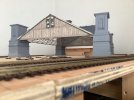

In this way, I can gain as much platform length as possible, albeit more akin to traditional train lengths of Hornby layouts of old than anything which might have actually departed a real life London terminus, but it is what it is. By doing so, the station will have its apron raised above the landscape like early stations of old such as the original Italianate designed Exchange station in Liverpool, with the inevitable climb facing the horses towing their hackney cabs via a series of ramps. I suppose by running the curved mainline sections below the ‘apron’, it will in effect be my version of this:

(Photo of a Hornby Dublo example found on eBay).
Positioning of the building in this way has also helped me imagine the final design of the platform facing side of the building (the side in the photos above is actually the ‘front’ of the building) such that the front elevation will sport only two storeys, the platform rear elevation, three.
The intention, however, was always to site the building - like so many other London terminals like Blackfriars- on the banks of Old Father Thames, occupying a commanding view above the city such that the owners were able to show off their dominance and highlight theirs and its progress towards modernism in doing so, such that when looking into the terminus from the railway, beyond is the river, perhaps strewn in mist? (Piddly excuse for the absence of a backscene). Unfortunately, space towards the baseboard end is tight, thus whilst I might be able to hint at a quayside with those water weary wooden vertical sections you seen along many quaysides of the Thames, I doubt there’ll be room for a Lighter (but I’ll do my damndest to try as they look very modellable).
In the dip to the left of the station as you look, will be sited the remains of the early abbey (probably just the tower, as the knave and cemetery were demolished to make way for the site of the ‘new’ station) once occupied by the monks who ferried passengers across the river for their penance and in doing so, provided the title of the station. My daughter bought me a couple of church kits a couple of Christmases ago for the purpose, but as an avid watcher of Mr. John Rogers’ videos on walking tours of London and its environs on YouTube, I’m struck by the number of old churches where only the tower remains and thus my idea to have had the greedy owners of the railway showing little regard in the name of progress and greed, by binning the rest of it. It will be a mooted point by future critics of the railway that the poor returns were due in some way to their sacrilege! In reality, the restricted site and unavailability of further land to purchase, meant that future expansion to accommodate longer modern stock meant shorter trains took longer to reach their destinations, having to stop along the way to have more coaches attached, thus passengers looking for swifter journeys were drawn to other stations and companies. Well, that’s my excuse.
jonte
Still, I’ve managed to join up the main lines and loop, just the station roads and sidings to be located.
So, what’s the point of this brief update?
Well, while I was about it and in an effort to determine the lengths of the platform roads, I thought it about time to finally ‘fix’ the position of the station building and show how I intend to locate it. It will also serve to provide the reader with a clue to how this scene will fit into the landscape.
Essentially, the building will be set above the curved track sections as shown sited on a couple of blocks of wood in the following:
In this way, I can gain as much platform length as possible, albeit more akin to traditional train lengths of Hornby layouts of old than anything which might have actually departed a real life London terminus, but it is what it is. By doing so, the station will have its apron raised above the landscape like early stations of old such as the original Italianate designed Exchange station in Liverpool, with the inevitable climb facing the horses towing their hackney cabs via a series of ramps. I suppose by running the curved mainline sections below the ‘apron’, it will in effect be my version of this:
(Photo of a Hornby Dublo example found on eBay).
Positioning of the building in this way has also helped me imagine the final design of the platform facing side of the building (the side in the photos above is actually the ‘front’ of the building) such that the front elevation will sport only two storeys, the platform rear elevation, three.
The intention, however, was always to site the building - like so many other London terminals like Blackfriars- on the banks of Old Father Thames, occupying a commanding view above the city such that the owners were able to show off their dominance and highlight theirs and its progress towards modernism in doing so, such that when looking into the terminus from the railway, beyond is the river, perhaps strewn in mist? (Piddly excuse for the absence of a backscene). Unfortunately, space towards the baseboard end is tight, thus whilst I might be able to hint at a quayside with those water weary wooden vertical sections you seen along many quaysides of the Thames, I doubt there’ll be room for a Lighter (but I’ll do my damndest to try as they look very modellable).
In the dip to the left of the station as you look, will be sited the remains of the early abbey (probably just the tower, as the knave and cemetery were demolished to make way for the site of the ‘new’ station) once occupied by the monks who ferried passengers across the river for their penance and in doing so, provided the title of the station. My daughter bought me a couple of church kits a couple of Christmases ago for the purpose, but as an avid watcher of Mr. John Rogers’ videos on walking tours of London and its environs on YouTube, I’m struck by the number of old churches where only the tower remains and thus my idea to have had the greedy owners of the railway showing little regard in the name of progress and greed, by binning the rest of it. It will be a mooted point by future critics of the railway that the poor returns were due in some way to their sacrilege! In reality, the restricted site and unavailability of further land to purchase, meant that future expansion to accommodate longer modern stock meant shorter trains took longer to reach their destinations, having to stop along the way to have more coaches attached, thus passengers looking for swifter journeys were drawn to other stations and companies. Well, that’s my excuse.
jonte