Monks Ferry: a layout for the Grandchildren.

simond

Western Thunderer
so you will have the following aspects?

Green
Green & Amber
Amber ?
Red

Green and Amber together will be a bit challenging if you want either or both independently - you cannot wire them in parallel in that case.

If that is what you want, you will have to bring individual wires from each LED to your switch and use a two-pole switch (or more)

something like this would work
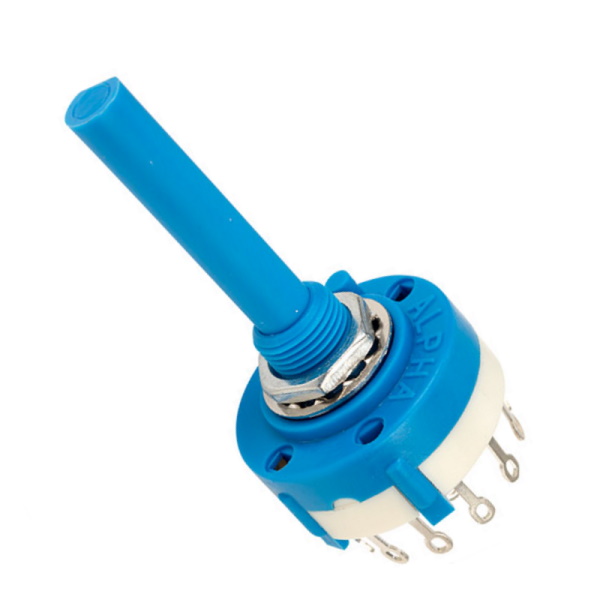

or


inevitably they do not show a photo of the back, which would help but they do have an excellent diagram


try your wiring like this;

1760011269152.png
 

jonte

Western Thunderer
so you will have the following aspects?

Green
Green & Amber
Amber ?
Red

Green and Amber together will be a bit challenging if you want either or both independently - you cannot wire them in parallel in that case.

If that is what you want, you will have to bring individual wires from each LED to your switch and use a two-pole switch (or more)

something like this would work


or


inevitably they do not show a photo of the back, which would help but they do have an excellent diagram


try your wiring like this;

View attachment 249195

Most generous, Simon, thank you :thumbs:

So what’s happening is (in base language of course) that when the led wire of one colour, say amber (sorry, Mike, YELLOW :))) is wired up to one pole, then if another colour, say green, is at 180 degrees to it in the opposite pole, then they light up together. And if the Yellow is wired to one side, but the position 180 degrees to it in the opposite pole is vacant, then only the yellow will light up.

Got it!

Thanks, Simon.

Jon
 

Roger Pound

Western Thunderer
Incidentally, I’m intending to keep things simple electrically by using on/on switches as most are simply red/green aspects which are easier for the children (and me) to understand.
In my humble experience grand-children rapidly become able to surpass we old timers in these fields, Jon. Just hang on and keep the bits in a safe place and they will have the signalling built up and working before you realise it...............:rolleyes:

Roger (the well known electrical dunce - :confused:).
 

jonte

Western Thunderer
In my humble experience grand-children rapidly become able to surpass we old timers in these fields, Jon. Just hang on and keep the bits in a safe place and they will have the signalling built up and working before you realise it...............:rolleyes:

Roger (the well known electrical dunce - :confused:).

Me thinks you underestimate yourself, Roger, but I appreciate the spirit in which you wrote it :thumbs:

Plenty of time to crash and burn yet on this little side project (if not the whole venture :(), but I’m willing to give it a couple more days worth of frustration and am beginning to enjoy the electrical challenge thanks to Simon’s generous contribution.
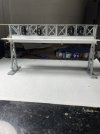
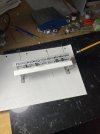
If it all starts falling to pieces in the meantime, I’ll check if I’m as good at volleying plastic kits as I was a footy ;)

Jon
 

jonte

Western Thunderer
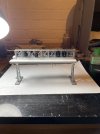
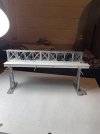
I’ve made a start on the walkways. They’re quite simple but I’m thankful that they sit accurately enough on the brass beams and don’t fall off, although the brass wire beams will need cutting to size.

The original has been kitbashed and this is the scratchbuilt one for the opposite side:

IMG_0191.jpegIMG_0192.jpeg

Now to finish the supports on the underside of the scratchbuilt one and dress them somehow with wooden planking and handrails.

jonte
 

jonte

Western Thunderer
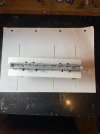
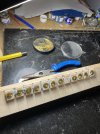
And at close of play, the planks are fitted to the platforms:

IMG_0195.jpegIMG_0193.jpegIMG_0194.jpegIMG_0196.jpeg

The planks are represented by some offcuts of embossed styrene I keep for a rainy day.

Next, I’ll make a top platform for engineers to access the second platform which will be a friction fit to the top of the gantry (there was one of this sort on the approach to Waterloo).

Then it’ll be fabricating soldered up handrails and drilling the platforms to fit.

That will pretty much see construction finished so that I can turn my attention to soldering some more LEDs whilst waiting for my switches to arrive.

Then painting and weathering, then probably the construction of a plinth upon which to mount it for testing.

Thanks for looking.

jonte
 

James Spooner

Western Thunderer
And at close of play, the planks are fitted to the platforms:

View attachment 249207View attachment 249209View attachment 249208View attachment 249206

The planks are represented by some offcuts of embossed styrene I keep for a rainy day.

Next, I’ll make a top platform for engineers to access the second platform which will be a friction fit to the top of the gantry (there was one of this sort on the approach to Waterloo).

Then it’ll be fabricating soldered up handrails and drilling the platforms to fit.

That will pretty much see construction finished so that I can turn my attention to soldering some more LEDs whilst waiting for my switches to arrive.

Then painting and weathering, then probably the construction of a plinth upon which to mount it for testing.

Thanks for looking.

jonte
That’s looking very good!

Nigel
 

jonte

Western Thunderer
Only half a day at the bench, most of which was spent hunting for a brass kit to relieve it of its brass handrails. Once discovered, I was disappointed to find that only a short length remained. It’ll probably do fir the shirt rails if the top platform when built.

Luckily, I discovered a longer length of thin steel wire amongst a forest of materials in a round tin on my desk. To be honest, it looks more to scale to my eyes than the brass wire.

Anyway,it was on to making another jig to fabricate one half of the handrails fir the long platforms:

IMG_0197.jpeg

The result:

IMG_0198.jpeg

Yeah, I know. Looks like a piece of wire stuck to several pins, but it will do for our purpose.

Now I’ve the materials to hand and a jig prepared, I can make better progress next time.

jonte
 

jonte

Western Thunderer
Another job another jig:

IMG_0199.jpeg

This is the handrail section for the upper platform showing construction in part.

And then after turning upside down fir soldering underneath, followed by tidying of sorts with files:

IMG_0200.jpeg

Now for the other half……

A second jig will be required fir the fitting of the stanchions, and initial thoughts are that handrail will have to be cut into sections to make the task a little more manageable before soldering it back together again.

jonte
 

jonte

Western Thunderer
The rail complete:

IMG_0201.jpeg

Then it was time to construct another jig of sorts, one which didn’t require me to cut the rails in half. However, I did myself no favours when it came to ease of soldering which caused one of the joints to pop and left a blister of unsightly solder on one upright:

IMG_0202.jpeg
IMG_0203.jpeg
IMG_0204.jpeg

I can live with it.

Just the platforms to drill out for the handrails and that’s the end of the construction aspect, although the rails won’t be fitted until after priming and painting.

A spot of good luck saw those rotary switches arrive a couple of day’s earlier than expected, so I’m eager to get on with some testing of led sequences.

Best.

jonte
 

jonte

Western Thunderer
As mentioned in my earlier post, the 2 pole; 6 way rotary switches arrived earlier than expected so I was eager to give it a go.

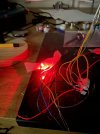
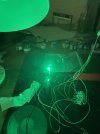
Following Simon’s @simond instructions to the tee, I gathered together as many bits of old wiring to hand, which were then cobbled together in a most untidy fashion and unsurprisingly, Bingo! It worked perfectly. And all in spite of my spaghetti like wiring and untidy soldering (all to be addressed):

Red:

IMG_0208.jpeg

Green:

IMG_0207.jpeg

Amber (apologies again, Mike : yellow!):

IMG_0206.jpeg

……..and best of all, yellow and green:

IMG_0205.jpeg

Many thanks once again, Simon, for taking the time to share your valuable knowledge and time.

I really am most grateful.

Jon
 

simond

Western Thunderer
Jon,

its great when a plan comes together! Delighted to see it working, and what super-surreal photos! (Particularly the green one!)

might I suggest some higher value resistors!

Or put a couple in series, or three, or four…. Once you’ve worked out what works you can then buy single resistors of the same (or similar) value.

cheers
Simon
 

jonte

Western Thunderer
I might look into at that at some stage thanks, Simon :thumbs:

For some reason, the yellow is relatively dim…..

Before all that, I’m thinking of returning the rotary switches themselves (Amazon purchase) as the rotary stem is quite difficult to….well, rotate. Usually straightforward procedure. Will try and get one them with a knob on although they seem to be dearer, but the children will have no chance of turning these:(

Jon
 

simond

Western Thunderer
I might look into at that at some stage thanks, Simon :thumbs:

For some reason, the yellow is relatively dim…..

Before all that, I’m thinking of returning the rotary switches themselves (Amazon purchase) as the rotary stem is quite difficult to….well, rotate. Usually straightforward procedure. Will try and get one them with a knob on although they seem to be dearer, but the children will have no chance of turning these:(

Jon
Jon,

You can have different value resistors on each LED to adjust the brightness individually. The only thing to be careful of is that the resistor value is too low, in which case the LED will be very bright, but only very briefly…. If you’re more than 1000 (1K) ohms, and less than 12V, all will be well.

and as Pete said, “knobs!”

useful suppliers for this kind of stuff:

Rapid
RS
Farnell
Squires

atb
Simon
 

jonte

Western Thunderer
Jon,

You can have different value resistors on each LED to adjust the brightness individually. The only thing to be careful of is that the resistor value is too low, in which case the LED will be very bright, but only very briefly…. If you’re more than 1000 (1K) ohms, and less than 12V, all will be well.

and as Pete said, “knobs!”

useful suppliers for this kind of stuff:

Rapid
RS
Farnell
Squires

atb
Simon

Thanks, Simon.

Yep, the resistors are 1K each.

I’ll check out the list of options from the retailers you’ve kindly posted, and I’m not sure whether you’ve seen Pete’s option he kindly posted, but I’m wondering whether any of them will fit as the shafts are the lengths of football pitches.

Do you think I could cut them down?

I suppose there’s only one way to find out…….

Best

Jon
 

simond

Western Thunderer
Jon,

yes, they’re normally a hard plastic, a razor saw or hacksaw will make short work…

I’ll bet they’re 1/4” diameter with a flat down one side too.

Simon
 
Top